
This time, I’d like to write about my own disability and daily life from the perspective of my relationship with technology.
At the end of 2021, I developed unexplained myelitis, making walking difficult.
I now use a wheelchair for daily life. The wheelchair has become one of the essential technologies for my life.
Using the wheelchair has helped me get quite accustomed to daily life, and lately I’ve been able to get around without much trouble. While indoor activities pose no problem, moving outdoors still presents challenges. Stairs are one such obstacle. I live in an apartment building where the elevator doesn’t stop at my floor, so I must somehow manage climbing and descending one flight of stairs.
That’s why I purchased an electric stairlift.
I bought a used electric stairlift from Abilities Care Net, a company that greatly assisted me with purchases like a nursing bed. While I sometimes climb the stairs independently as part of my rehabilitation, I use this stairlift almost every day. It’s become another indispensable piece of technology in my life.
The other essential technology is my car equipped with a manual driving device. I use it for daily commutes and outings.
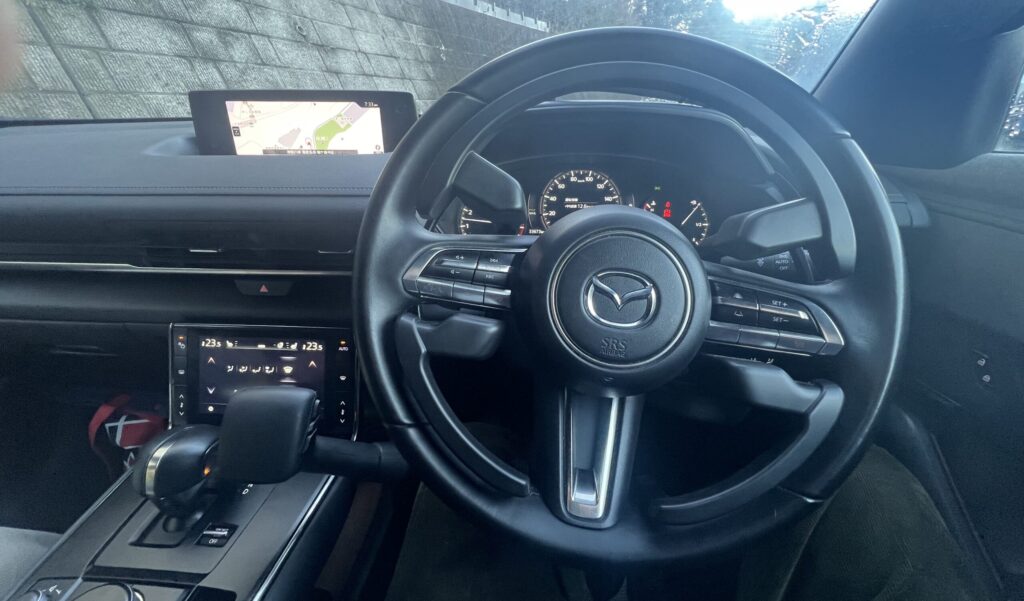
I drive a MAZDA MX-30 Self-empowerment Driving Vehicle (SeDV), which my eldest son found for me. This is a welfare vehicle based on the MX-30, modified with a manual driving device.
https://www.mazda.co.jp/cars/mx-30/grade/sedv/
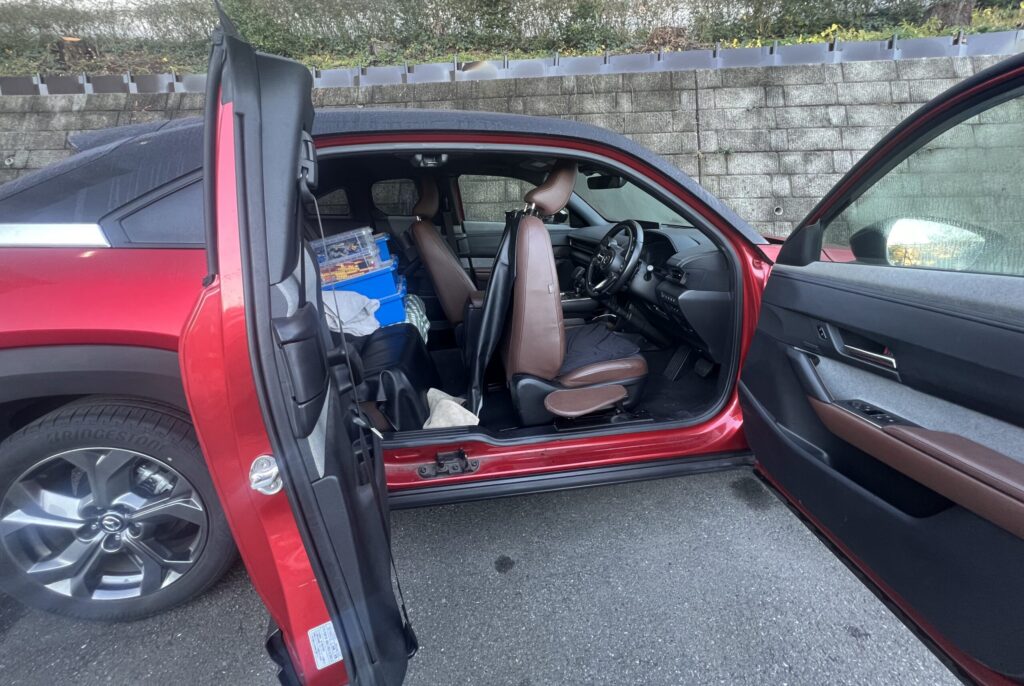
An accelerator ring is mounted inside the steering wheel; pressing it applies the throttle. A lever is attached for brake operation with the left hand. This lever connects to the brake pedal, functioning like pressing a foot brake with your hand. Before purchasing, I received direct operation instructions from Mazda’s development staff. According to the representative, hands allow for more precise control than feet. While turning the steering wheel while accelerating does require a bit of practice, I feel I can achieve more delicate acceleration and braking control than with foot operation. Another major advantage is the sliding doors, which allow direct loading of a wheelchair into the rear seat.
When using public transportation to get to university, it takes about 7 minutes from my apartment to the nearest station, but it involves a continuous gentle uphill slope. Climbing it independently is difficult, so I need my family to push me to the station. Once at the station, I ask station staff to place a ramp between the platform and the train for boarding. They also notify the staff at my destination station, so I never have trouble getting on or off the train.
In my case, I can travel from the nearest station to Shibuya Station without transfers. From Shibuya Station, I take a route bus to the university entrance. The bus driver also assists with boarding and alighting, so there are no problems. Staff members also help with navigating the complex Shibuya Station. While I need support from various people, both the travel time and the fatigue associated with moving are incomparably greater than commuting by private car.
I believe it’s only because of this car that I can attend university five days a week (sometimes even six or seven days!). Beyond just being a convenient means of transportation, the real appeal of this car is that driving it is simply enjoyable. Since becoming wheelchair-dependent, I find working more enjoyable than ever before, and being able to commute with this car is likely one reason why.
Using this car, I experience daily the profound gratitude I feel for the technology that helps overcome physical limitations. Of course, my wheelchair and stairlift are also technologies that assist with my mobility limitations. Until now, I feel I was too focused solely on technologies that make daily life and work better and more convenient. However, naturally, the role and potential of technology extend far beyond that. As someone directly affected, this has become a valuable daily opportunity to reflect on technologies that overcome limitations through real-life experience.
Regarding technology in education, I also feel I used to think only about how it could enrich learning. Many people face barriers to learning. I’m also thinking about technology that overcomes these barriers to learning through practical experience.
Barrier-free design benefits everyone, regardless of disability. I want to take time to think about educational design for barrier-free learning.
Incidentally, regarding cars, even if I were no longer physically disabled, I might still choose my current manual-assist vehicle. I aim to create tools for barrier-free education that people would want to use even if their disability disappeared.