
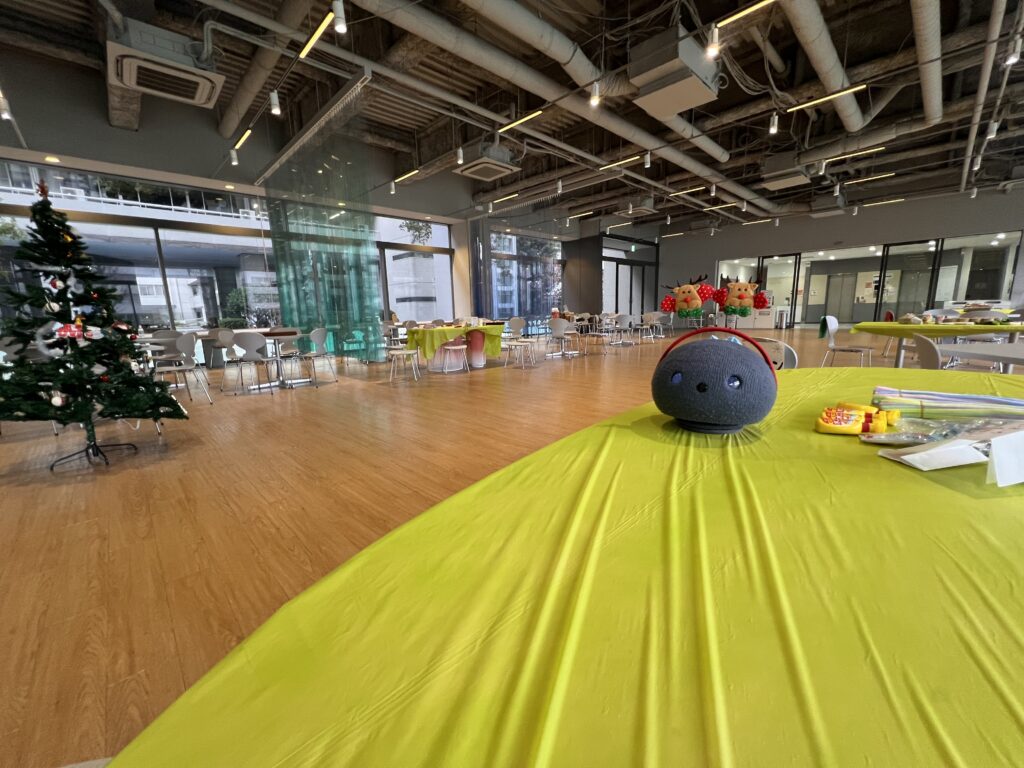
The Children’s Workshop “Come One, Come All: Christmas Party,” planned and run by third-year students in the Mori Seminar, was held on Sunday, December 21, 2025, at the Student Hall in Building 8 of Showa Women’s University.
For details about the workshop and student reflections, please see our department blog here.
Once again, everything from planning and preparation to the day-of operations was entirely entrusted to the students. My (faculty) role was limited to ordering the materials needed for the day, recruiting participants via the event site (Peatix), and handling internal university procedures like registration and venue reservations.
It turned out to be such a wonderful workshop that I found myself wanting to emulate it.
Here, I’ll list a few points that made me think, “I want to try this.”
First, the workshop design process.
It wasn’t based on one person’s idea; all nine seminar students collaborated on it. Once the activity outline (what to create) was roughly decided, they split into smaller groups to prepare the specific activities.
Watching from the sidelines, their teamwork was so smooth and pleasant to observe that preparations progressed rapidly. What’s more, they seemed to be having a great time. The atmosphere during workshop prep was so inviting that I almost wanted to join in myself.
We don’t document the workshop flow in written materials.
When planning workshops, it’s common to organize the flow in a lesson plan format. While this is highly effective for clarifying the sequence and enabling multiple facilitators to collaborate, it inevitably tends toward a one-way structure. Furthermore, it’s not uncommon to unconsciously become fixated on executing things exactly as planned.
If the strength of a workshop as a learning space lies in participants gaining insights through collaborative activities with those gathered at that moment, then a one-way, monologue-like workshop might fail to fully leverage that strength.
In that sense, I felt it was important not to create a detailed plan, but rather to keep it to jotting notes on a whiteboard, then verbally sharing the workshop vision while working through preparations. I sensed that casual conversation, different from formal meetings, was crucial—even allowing discussions to veer off track and become seemingly pointless at times.
In Japan, workshops for children often seem to have a clearly defined flow set in advance. When I started facilitating workshops in the 2000s, I too consciously focused on creating detailed workshop plans, almost like lesson plans.
Writing things down not only clarifies the flow but also allows you to simulate various possible developments on paper. Precisely because workshops are activities where the activities and learning can vary greatly depending on the participants, I believed it was important to anticipate every possible scenario beforehand.
Certainly, this is effective for sharing what we want to achieve in the workshop, including with the facilitators participating on the day. However, it also means that we are fixing the workshop as “what we want to do” at this point, even though it is inherently something that can change based on the participants. As a result, it’s not uncommon for the workshop to become nothing more than going through the planned content in sequence.
In that sense, while we decide on the activities and overall flow, keeping these shared only among the organizing staff and avoiding overly detailed planning may ultimately be what allows the workshop to function as a “learning space.” Participating peripherally in the student-run workshop gave me a chance to reflect on this myself.
Regarding workshop operations, while roles are defined, the division of responsibilities does not place excessive burden on any individual.
This applies not just to workshops but to work in general: when assigning roles by rigidly linking responsibilities—say, “This part is for XX, that part for YY”—it can fragment the overall activity. While clarifying responsibility is important, in a community built on the trust that “someone will handle it,” such strict division may not be necessary.
In this workshop, I actually did very little myself. I had my assistant handle ordering materials, and I mostly just handled participant recruitment via Peatix (the recruitment text was written by students).
If I had to point out specific actions, it would be adding materials and tools I thought might be needed from what I had on hand, and making an effort to speak to every participant, including the adults.
I also feel workshops are like living things.
That workshop can only happen with the specific members gathered in that place on that day. Even if the content and members were the same, it would be a completely different workshop on a different day. That’s because we, the participants, ourselves are changing every day.
Perhaps it’s fair to say that all activities, not just workshops, exist within the ever-changing relationships between ourselves and others. This workshop made me reconsider how school lessons, seminars, and work are all conducted within the context of our daily interactions with others—interactions that are constantly shifting.
When using workshops as subjects for educational practice research, evaluation is always a challenge. Previously, I’ve attempted evaluation through the works themselves, reflections on the works, participant questionnaires, and interviews.
While these provide partial evaluations, I cannot shake the feeling that they fail to fully capture the essence of what was experienced in the workshop. I suspect that viewing the workshop as a “living thing” might offer some clues. Of course, if we try to categorize it like a living things encyclopedia, we risk reverting to a static understanding again…
I intend to explore this point in greater depth in future writings.
What surprised me most about this workshop happened right after it ended.
Unlike usual workshops, the students immediately began creating their own pieces.
Watching the children work seemed to inspire them to create. That’s a workshop in the truest sense.
Once again, I extend my deepest gratitude to everyone involved in this workshop.
Thank you very much.