
On September 24th and 29th, we conducted remote programming workshops using OctoStudio at the Keyaki Classroom (special needs classroom: resource room) of Hachioji Municipal Elementary School No. 9. This marks the third year of remote outreach classes at the Keyaki Classroom. This time, we held a total of five workshops over the two days. Each session provided a valuable opportunity to reflect on what kind of support we can offer children through remote workshops, while engaging in activities alongside the children and teachers.
Regarding remote programming lessons, we are given the opportunity to consider, through practice, not only how to improve and model the methods, but also how the workshops can support the children and teachers participating in achieving goals they are working towards continuously, not just during this time. This time, the goals were to listen carefully and to ask questions.
Naturally, listening to a teacher across a screen remotely requires even more concentration than listening in person. Asking questions remotely is a challenging activity for everyone, regardless of age. First, approaching someone remotely for the first time (some children had worked with us last year too), and then figuring out how to convey what they want to know or ask remotely, is a significant challenge for the children (and adults too).
This time, we named it a “Question Corner” and had the children come to the monitor to ask questions or show their work. It was like a booth on a TV food show where you get recommendations for local delicacies from all over Japan.
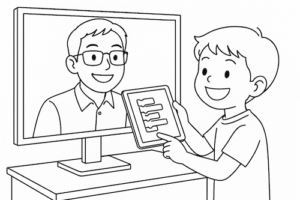
Each child has a teacher assigned to support them. We start by having them come to the monitor together and say “Hello.” Then, we look at the work they’re creating and discuss any challenges they’re facing in their projects.
To help shape their ideas or solve problems, we display sample programs on the screen. When working with a child who wants to use a specific image as a sprite, we might use generative AI to draw it together. Or, when looking at a project they’ve shown us, we might suggest, “You could also try doing this.” These moments make it feel like we’re participating in a face-to-face workshop, not a remote one.
Resnick et al. (2009) identified three reasons why early programming education in the 1980s failed: the tools themselves were difficult to use, and the possibilities for what could be done with them were limited. New tools like Scratch and OctoStudio overcome this challenge by allowing programming with block-based commands instead of text, enabling the creation of more diverse projects. Another reason cited was the failure to provide “appropriate advice at the appropriate time.” Scratch’s community features help address this, but they aren’t necessarily sufficient. The best approach for timely, appropriate guidance is, of course, observing children in real-time and providing support on the spot.
The questions posed at this booth require children to decide the right moment themselves, muster the courage to approach the booth, and then explain their work—all challenging steps. However, creating something they find personally meaningful (a Personally Meaningful Artifact) might be the driving force that helps them overcome such difficulties. Also, this remote Q&A booth was simply connected via an online meeting, so there’s room for improvement in the technology itself. Yet, precisely because the technology was rudimentary (the bare minimum), I sensed the potential that if you have something you want to convey, it can amplify that desire to communicate even more.
Watching these children and their creations, I find myself genuinely saying “Nice!” and “Amazing!” over and over (I should count how many times I say it in a single workshop next time).
The communication with the children and the adults involved in the workshop, fostered through the process of creating artworks, is my greatest motivation for continuing these workshops. I am filled with gratitude for the children who repeatedly bring their creations to show me on the monitor, both during and after the workshop.
Thank you again for this session.
References
RESNICK, M. et al(2009)Programming for All Communications of the ACM Vol.52 No.11:60-67
https://dl.acm.org/doi/10.1145/1592761.1592779