
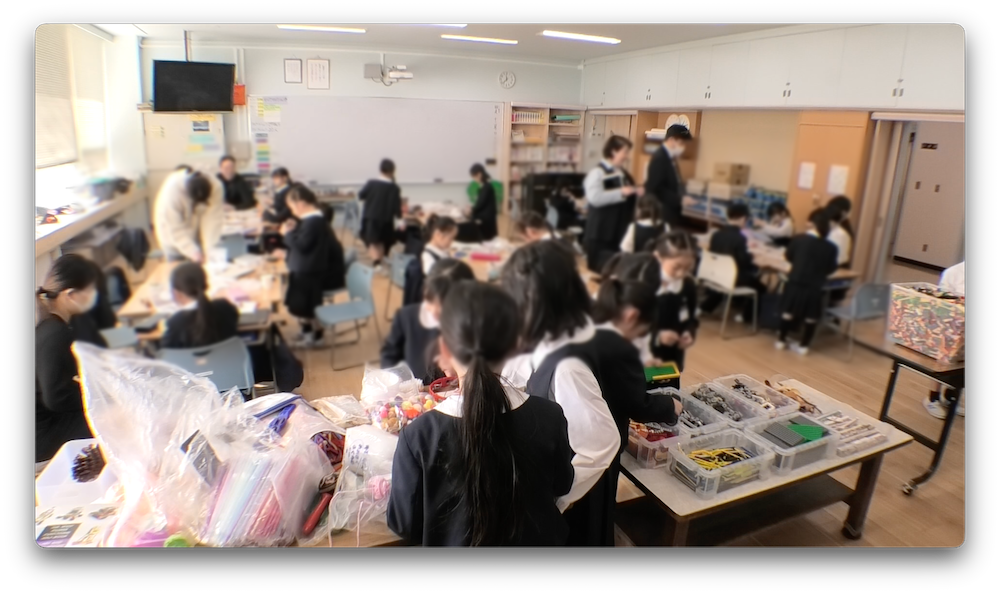
Following last year’s event, I held an outreach class on December 11th for first-year students in the Inquiry Course at Showa Elementary School, affiliated with Showa Women’s University.
This time, with the theme “Making Toys that Move with Computers,” students used programmable batteries, LEGO® blocks, craft materials, and recycled materials to create projects that performed interesting movements.
The programmable battery is a battery-powered computer that allows you to program patterns for turning a motor on and off using button controls. Building on last year’s experience with the children, I added a low-speed motor and a switch to change the rotation direction. It’s been 15 years since I created the first version. While it’s a simple mechanism that only allows creating on/off patterns, its ability to be used without a PC has made it ideal for outreach classes, especially for lower elementary grades.
As the project began, calls of “Teacher!” could be heard from all around the classroom.
These “Teacher!” calls can be broadly categorized into two types: those seeking to share something and those asking for support. The tone of voice naturally conveys which type of “Teacher!” it is. In programming education, providing necessary support at the right moment is crucial, as pointed out by Professor Resnick of MIT, who developed Scratch and the OctoStudio programming app for smartphones and tablets.
Particularly when children who need support call out “Teacher!”, it’s often difficult to judge how much and to what extent to respond. During outreach classes, it’s hard to grasp the children’s daily learning patterns, making it easy to fall into the habit of trying to respond to every child who calls out “Teacher!”. As a result, support can sometimes become skewed towards children who call out loudly or repeatedly.
If we understood each child’s usual learning patterns and the background leading up to that day’s lesson, the context behind their “Teacher!” might become clearer, making it easier to consider what support is needed. With 30 children, each engaged in their own activity, I felt it was necessary to consciously take time during the lesson to observe and survey the entire group to grasp each child’s situation.
In children’s workshops, when there is operational flexibility, facilitators may be assigned to oversee the entire floor. Additionally, when facilitators are familiar with each other, they may implicitly take turns assuming this oversight role.
In contrast, during outreach classes with limited staff, we’re often overwhelmed responding to calls of “Teacher!” and end up rushing nonstop until the end, with time flying by. While this can still provide a certain satisfaction as participation and contribution to the workshop, having five students join us this time allowed us to support the children with a bit more breathing room.
Leveraging the advantage of having the affiliated elementary school on the same campus (in the adjacent building), we hope to actively involve students in future sessions. Furthermore, to ensure the experience also serves as learning for the participating students themselves, I plan to explore how best to support those students who are called upon less frequently.
I extend our heartfelt gratitude to the teachers and children of the affiliated Showa Elementary School for providing us with this valuable opportunity.
I look forward to your continued support.